How to Run a Clipping Program That Grows Your Channel (Without Losing Control of Your Brand)
A creator's playbook for clipping programs in 2026: in-house vs clipper networks vs per-view campaigns, writing the brief, paying fairly, protecting your brand and measuring what works.
By the Salvo Team
6 min read
Updated
On this page
If you stream, podcast or make long YouTube videos, people are probably already clipping you. The question isn't whether clips of you exist. It's whether they're good, whether they credit you, and whether they bring viewers back to your channel.
A clipping program is how you take control of that: you decide who clips you, what they clip, how they're paid and how you measure it. Done well, it can be one of the cheapest ways to reach new viewers. Done badly, it floods the feeds with low-effort reposts and out-of-context moments that you then have to explain.
Three ways to run a program
Option 1: In-house (you, an editor, or a small team)
You or someone you pay directly makes every clip and posts it to your own accounts.
- Pros: full control of tone and quality; clips live on your official accounts; no brand surprises.
- Cons: volume is capped by your team's hours; the clips only reach people who see your accounts.
- Best for: creators whose brand depends on precision (educators, business creators, anyone in a regulated niche).
Option 2: A clipper network
You recruit a group of clippers, usually through a Discord channel, give them permission and a brief, and pay them per clip or per view. They post on their own accounts.
- Pros: volume and reach. Dozens of accounts, each with its own audience, testing different moments and hooks.
- Cons: you have to manage it: rules, payouts, and the occasional clipper who takes things out of context.
- Best for: streamers and personalities with lots of footage and a fan base that already makes clips.
Option 3: Per-view campaigns on a marketplace
You post a campaign on a marketplace such as Whop's Content Rewards, set a rate per 1,000 views and a budget, and approve or reject submitted clips. The marketplace handles payouts. Per Whop's docs, you can also set a minimum and maximum payout per video and choose which platforms count. Whop's Content Rewards terms set a fee of 10% of what you pay out to participants.
- Pros: you only pay for views; payouts and tracking are handled for you; easy to start and stop.
- Cons: reviewing submissions takes time; clippers optimise for views, so your brief has to protect your brand.
- Best for: launches, events and specific pushes (a new series, a book, a tour).
Many creators combine these: an in-house editor for the official accounts plus a campaign or network for reach.

Write the brief before you recruit anyone
A clear brief is the difference between clips you're proud of and clips you have to report. Cover these:
- What to clip. Topics, recurring segments, catchphrases, the kinds of moments that represent you well.
- What never to clip. Guests who haven't agreed, sensitive personal moments, sponsor reads, anything under embargo.
- Context rules. "Don't cut a sentence so it means the opposite" sounds obvious until it happens.
- Credit. Your handle on screen or in the caption, and a link in the clipper's bio.
- Format. Vertical, captions required, length range, whether your logo or a watermark is required.
- Platforms. Which ones count for payment, and whether clippers may post on all of them.
- Disclosure. If you pay clippers, the clips may count as paid promotion where you and they live. Tell clippers how to disclose it (platform tools, #ad, or whatever applies).
- Payment. Rate, how views are counted, when you pay and how.
Pin it. Update it when something goes wrong. Every rule in a good brief exists because something went wrong once.
Paying clippers fairly
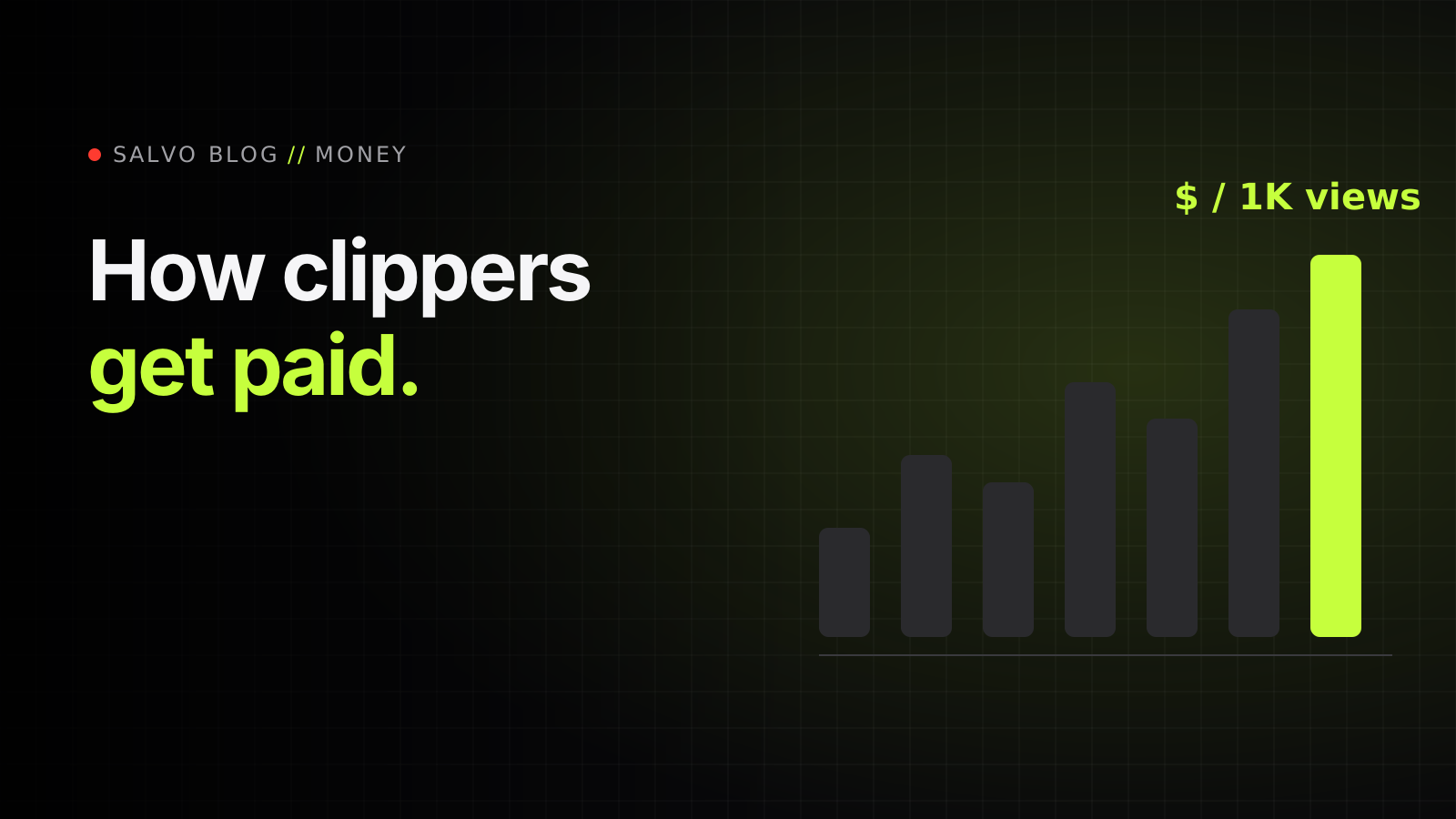
There's no standard rate, but there are reference points. Third-party guides put standard clipping campaigns on Whop at roughly $1 to $3 per 1,000 views (OpusClip's August 2026 guide). At the high-volume end, Tubefilter reported in April 2026 that the Kick streamer N3on pays $40 per 100,000 views across a network of about 1,000 clippers.
Things to decide upfront:
- Per view or per clip? Per view rewards results; per clip rewards effort and is better for in-house work.
- A cap per clip. Protects your budget if one clip explodes.
- A minimum before review. Saves you reviewing clips nobody watched.
- Payout timing. Weekly or monthly, and stick to it. Paying late is the fastest way to lose your best clippers.
Protecting your brand
Platforms are cracking down on unoriginal content: Instagram reduces the reach of accounts that mostly repost others' material, and YouTube's reused-content policy excludes clips edited together "with little or no narrative" from monetization. That's good news for you, because it pushes clippers toward real edits. It also means you should:
- Ask for transformation: a real hook, context, captions, framing. Not raw re-uploads.
- Review before paying, at least for new clippers.
- Keep a short list of trusted clippers who can skip review.
- Have a takedown process. Clippers agree upfront to remove a clip if you ask, no argument.
Give your clippers better raw material
The faster clippers can find good moments, the more of your content gets clipped well. Things that help:
- Timestamps or chapter markers for your best moments.
- Clean audio and a visible facecam (for streams), so vertical layouts work.
- A shared folder of approved assets: logo, intro card, fonts, colours.
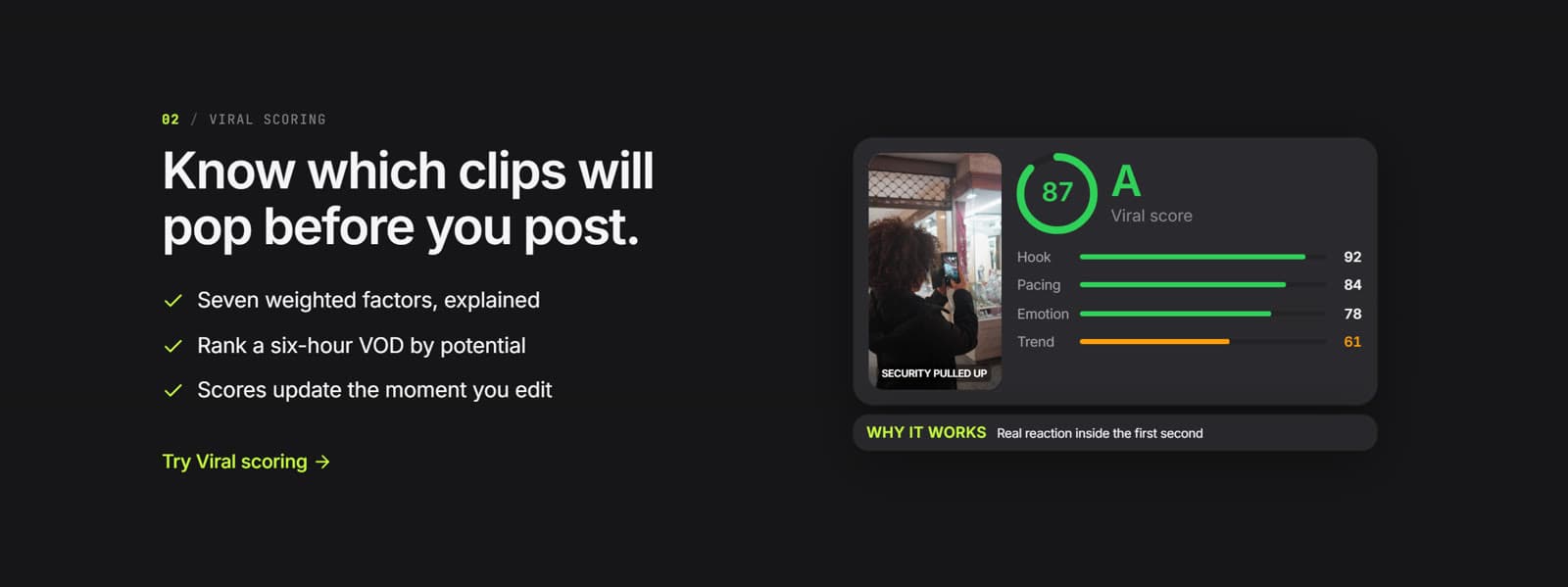
If you do any of the clipping yourself, a tool that finds the moments for you saves the most time. Salvo reads Twitch chat spikes, loudness and YouTube's most-replayed data, then cuts each spike into a vertical clip, scores it and explains the score. Your editor starts with a ranked list instead of a six-hour timeline.
Measure what matters
Views are the headline, but they aren't the goal. Track:
- Views per clip and per clipper, to see who's worth more budget.
- Retention and completion, because clips people finish are the ones that make them curious about the full video.
- Profile visits and new followers on your main channel during the program.
- Search and branded traffic, such as people searching your name or show.
- Cost per new follower or subscriber, which is the number to compare against ads.
Run the program for at least a month before judging it. Clips can keep getting views for weeks after they're posted, so early numbers usually understate the result.
Testing which version works
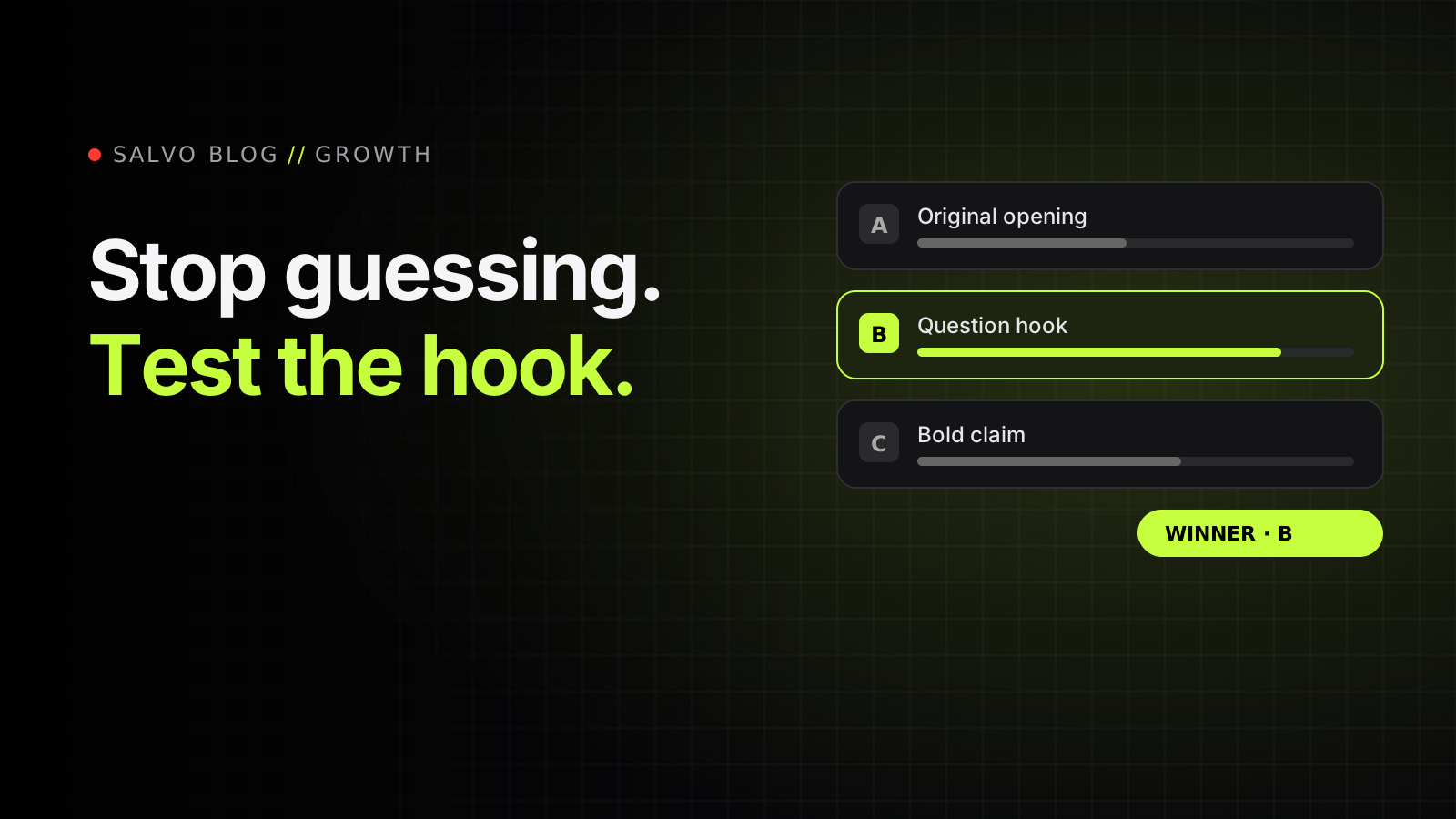
The same moment can do ten times better with a different first line. If you post on your own accounts, test it: make two or three versions of a clip with different hooks, post them to different accounts and keep the one that holds viewers longest. Salvo's Hook Lab does exactly this: it posts versions of the same clip to different accounts and picks the winner from real retention and click-through numbers. We go deeper in how to A/B test hooks.
A one-page checklist
- Pick the model: in-house, network, campaign, or a mix.
- Write and pin the brief: what to clip, what not to, credit, format, platforms, disclosure, payment.
- Set the money rules: rate, cap, minimum, payout schedule.
- Protect the brand: transformation required, review, trusted list, takedowns.
- Help clippers: timestamps, clean audio, an asset folder.
- Measure: retention, followers gained, cost per follower, not just views.
The creators who get the most out of clipping treat clippers as partners. Give them good material, clear rules and timely pay, and they'll bring your content to people who'd never have found the full video.