Stop Guessing: How to A/B Test Hooks on Short-Form Video (and What a Viral Score Can't Tell You)
How to run fair hook tests on short-form video: what to change, which metrics to judge by, how long to wait, and how predictive viral scores fit in (and where they fall short).
By the Salvo Team
5 min read
On this page
Every clipper has posted a clip they were sure would pop, watched it die at a few hundred views, then watched a throwaway clip pass 200,000. Short-form is noisy. One post's numbers tell you very little, and gut feeling tells you even less.
The fix is the same one marketers have used for decades: test. Make versions that differ in one thing, show them to comparable audiences, and let the numbers decide. This guide covers how to do that properly for short-form clips, and how predictive tools like viral scores fit in alongside real tests.
Why test the hook, of all things?
You could test anything: length, captions, music, thumbnail, post time. Start with the hook because:
- It's where most viewers leave. If people swipe in the first second or two, nothing later in the clip gets a chance.
- It's cheap to change. A new on-screen line or a different start point takes minutes; re-cutting a whole clip doesn't.
- The lessons carry over. Finding out that your audience prefers questions to bold claims improves every future clip, not just this one.
What a fair hook test looks like
Change one thing
If version B has a new hook and a new caption style and a shorter ending, and it wins, you don't know why. Keep everything identical except the hook: same cut, same captions, same audio. (Once you've found a winning hook, test the next thing.)
Show versions to comparable audiences
Posting version A today and version B next week isn't a fair test: the feed, the trends and your account's momentum all changed. Better options:
- Different accounts, same niche, same time window. If you run several pages, this is the cleanest setup.
- Same account, spaced out, if you only have one. It's noisier, so you'll need more tests before trusting a pattern.
Judge by the right numbers
Total views are the noisiest metric because they depend on how far the algorithm pushed the post. For hooks, look first at:
- Early retention: how many viewers are still watching a few seconds in. This is the hook's direct job.
- Swipe-away rate: YouTube Shorts shows "viewed vs. swiped away" for each Short; it's the inverse of the same idea.
- Click-through and engagement, for the share of people who did something after the hook worked.
Wait long enough
Short-form posts get most of their early distribution in the first day or two, but numbers keep moving after that. Compare versions at the same age (for example, 24 hours after posting each one), and don't call a winner off the first hour.
Repeat before you believe it
One test is an anecdote. If question hooks beat bold claims in five tests across different clips, that's a pattern worth acting on.

A simple test plan
- Pick a clip you think is strong.
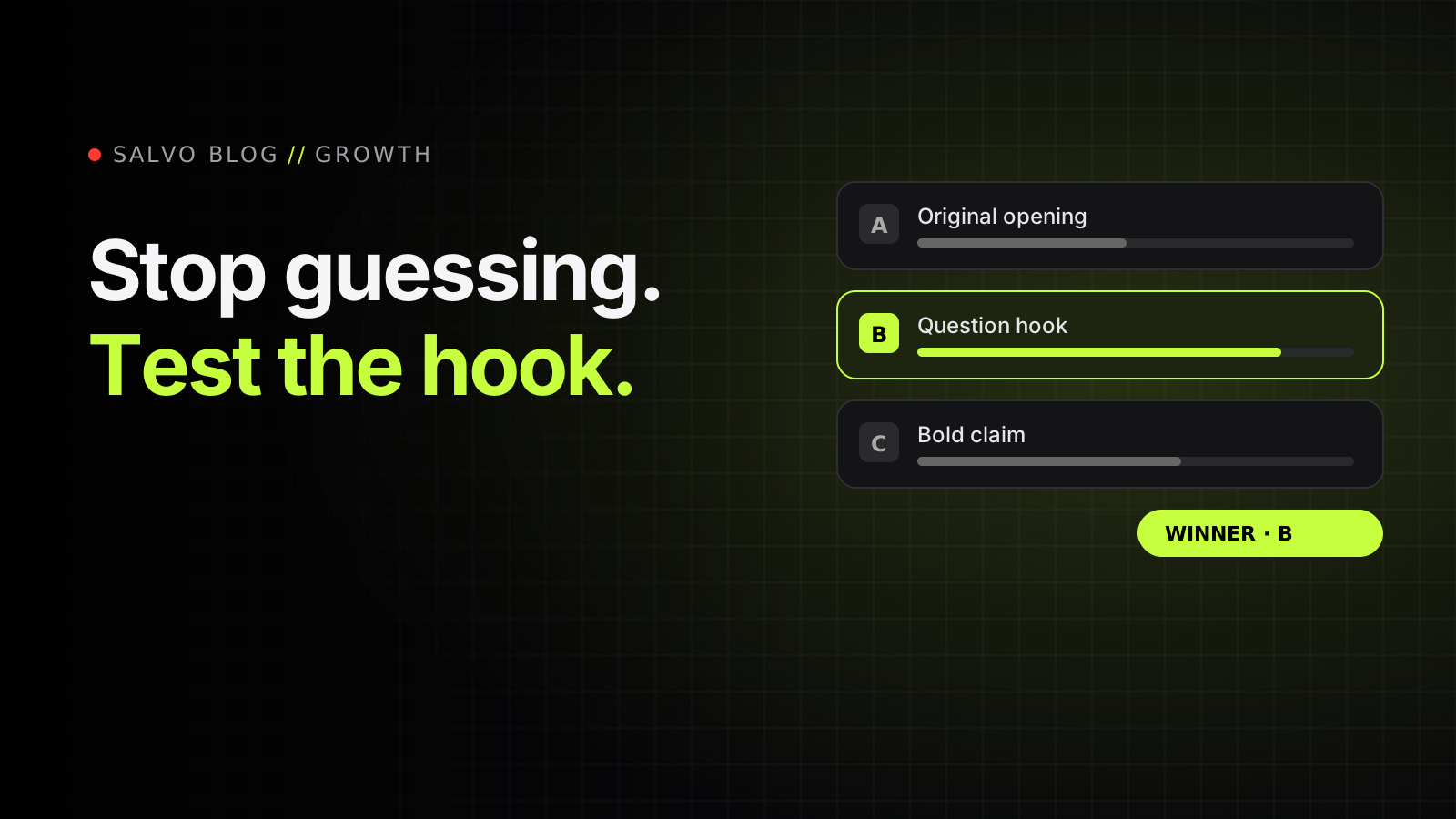
- Write three to five hooks of different types: an open loop, a bold claim, a question, a stakes line, a reaction-first opening. (Templates in our hook guide.)
- Make one version per hook, identical otherwise.
- Post each version to a different account in the same niche, within the same few hours.
- After 24 hours, compare early retention first, then engagement.
- Apply the winning hook wherever the clip goes next, and log the result.
How Salvo's Hook Lab runs it
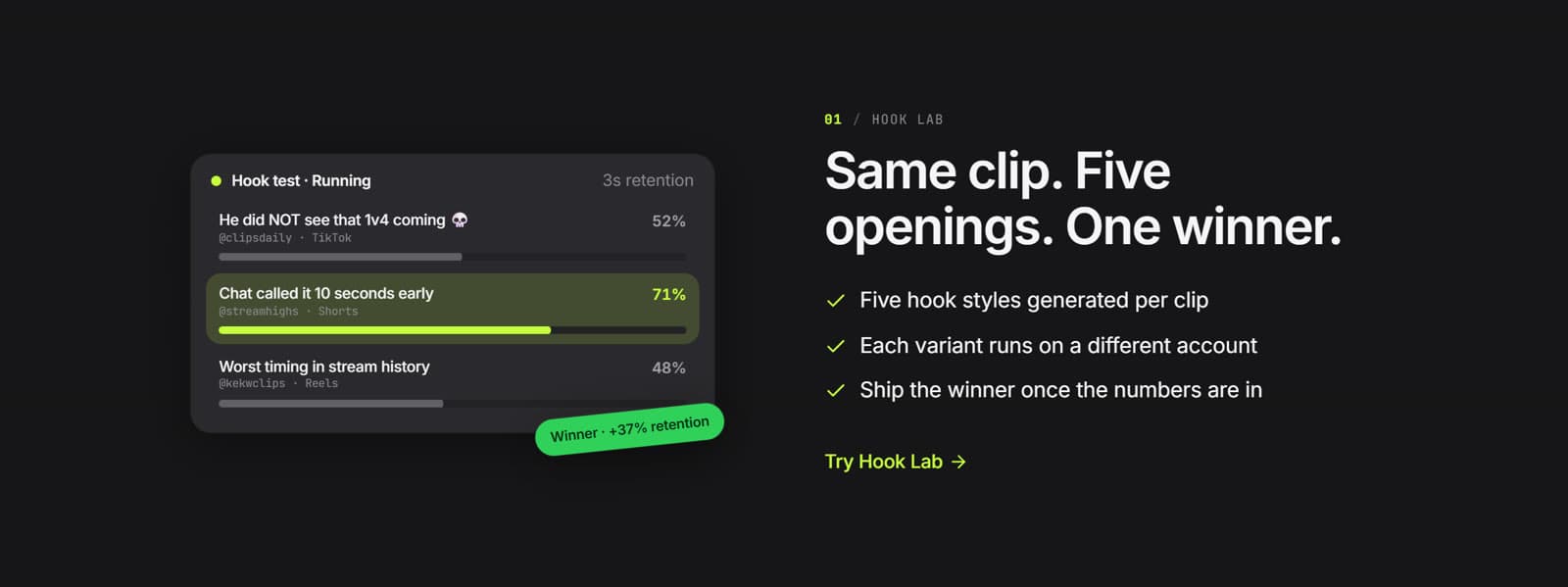
Running that plan by hand means a lot of renders, uploads and spreadsheets. Salvo's Hook Lab automates it:
- Versions are real copies of the clip. Each version (up to five in a test, counting the original) can be edited in the normal clip editor, and Hook Lab lists what each one changes: a new hook, different subtitles, cuts, framing and so on.
- Hooks come from the clip itself. Salvo generates alternative opening lines grounded in the clip's transcript when there is one.
- Each version posts to a different account, and each is rendered once and then frozen, so editing a version mid-test doesn't change what the test is measuring.
- The winner is picked from real post metrics, early retention and click-through, and you can apply it to the clip with one click.
Where viral scores fit in
A viral score is a prediction made before you post. Salvo scores every clip from 0 to 100 using seven weighted factors: the hook carries the most weight (26%), then pacing and emotion (14% each), clarity, length and captions (12% each), and trend fit (10%). Each score comes with a plain-language explanation, such as "Decent but beatable: the hook is strong, but pacing is holding it back", so you know what to fix.
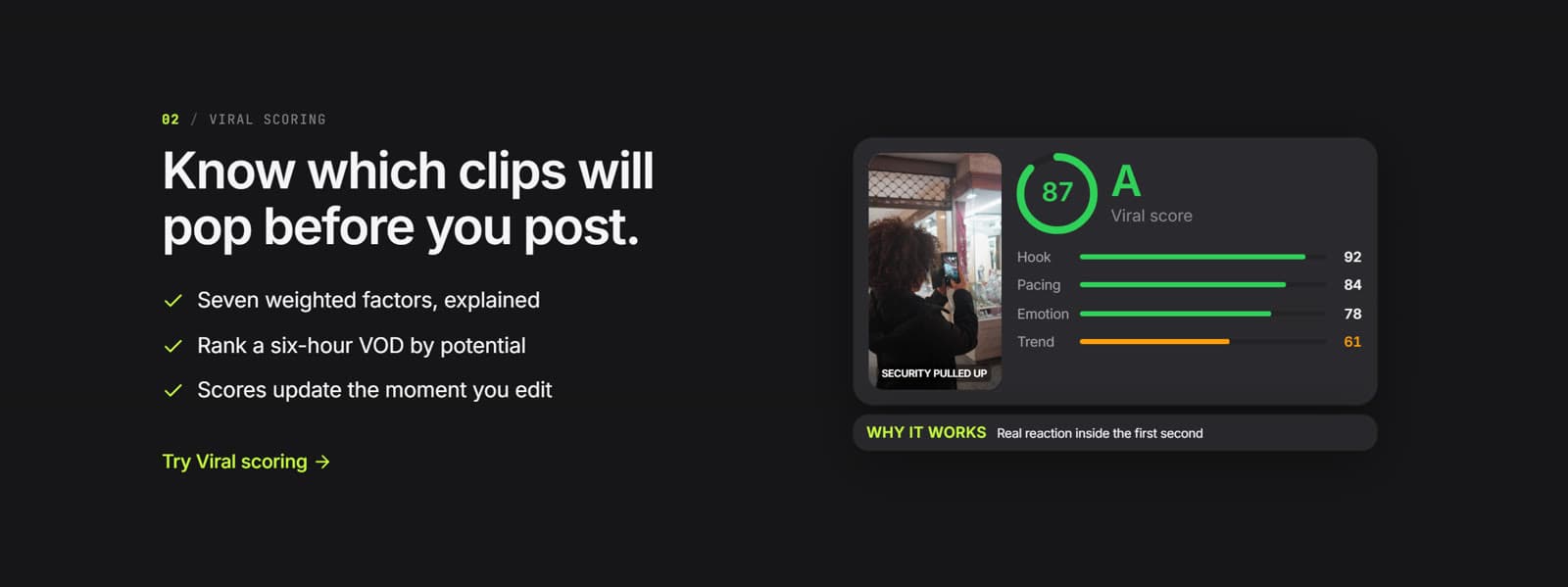
Scores are useful for:
- Triage. Ranking 40 clips from a long stream so you look at the best ones first.
- Catching fixable problems. A low captions or length score points at a fix you can make in a minute.
- Picking what to test. High-scoring clips are good candidates for a hook test.
What a score can't do:
- Know your audience. It doesn't know that your followers love one streamer's catchphrase.
- Predict the algorithm on a given day. Trends, timing and luck all matter.
- Replace a test. Salvo's scores are heuristics, not a trained model of your account's results. They're a fast first opinion. The test is the verdict.
The healthy workflow is: score to choose, test to decide. Use the score to pick which clips deserve attention, then let real viewers pick the hook.
Common testing mistakes
- Testing tiny differences. "Wait for it" vs "Wait for it..." won't teach you anything. Test different types of hooks.
- Calling it early. The version ahead after an hour often isn't the one ahead after a day.
- Posting identical videos everywhere. Platforms push back on duplicate, unoriginal content. Real variation (a different hook, a different caption style) is both a better test and a safer posting habit.
- Not writing it down. If you don't log results, you'll run the same test again in three months.
Testing turns short-form from a slot machine into a craft. You still won't win every post, but you'll know why the winners won, and you can do it again.